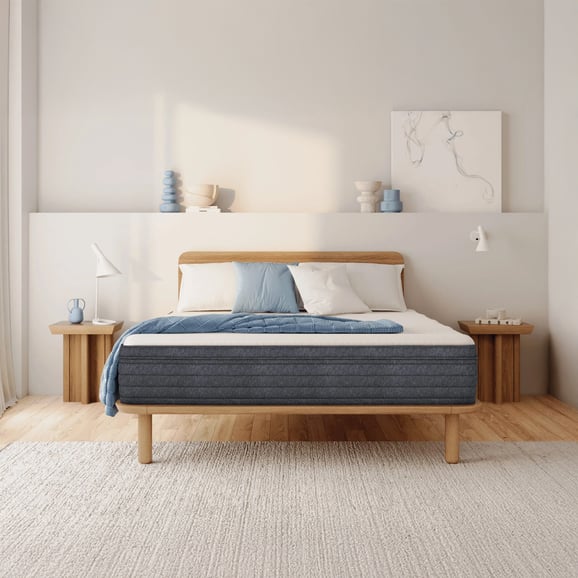
Marks and Spencer sells mattresses the way you'd expect Marks and Spencer to sell mattresses. Quietly, without marketing fanfare, as part of the Home and Furniture range, and with the kind of consistent mid-market construction quality that has defined the retailer since before the mattress category existed. They're not the most exciting option on the UK market, and they're not trying to be, but for buyers who want a dependable pocket spring mattress from a brand they already trust for everything else in their home, M&S is a sensible starting point.
The range sits between the budget end of the market and the heritage premium tier, with prices that typically land between £300 and £900 depending on spring count and construction. All models carry a 10 year guarantee, which matches the industry standard and sits well above Elle Decoration's 1 year cover or the shorter warranties some rivals offer. The mattresses are made in Great Britain on selected lines, with natural fibre comfort layers across most of the catalogue. For buyers whose main requirement is a competent British-built pocket spring mattress without the hassle of researching a dedicated mattress brand, the M&S range delivers that proposition cleanly.
How the M&S Mattress Range Is Structured
The range is organised by spring count instead of by named model series, which is unusual in the UK mattress market but works well for a retailer that prioritises clarity over branding complexity. Picking your model is mostly a matter of choosing the right spring count for your weight and preferences, with each tier offering a firm and a medium option.
The 1000 Pocket Spring range is the entry tier, available in medium and firm tensions with pure new wool and cotton natural fillings. The firm option uses the same construction with a stiffer spring tension and sits well with back sleepers who want proper underlying support without reaching up into the premium price tiers.
The 1050 Natural Pocket Spring sits as a small step up from the 1000 range with slightly more natural fibre content in the comfort layer. It's the choice for buyers who want the natural fibre feel without paying for the higher spring counts, and the medium tension works well for average weight sleepers across most positions.
The 1500 Pocket Spring range is where most M&S buyers end up. Available in medium and firm, with pure new wool padding, natural breathability and four side vents for airflow. The 1500 is the sweet spot of the range for most buyers, and the one I'd point people towards first unless budget rules it out or body weight pushes them towards the 2500.
The 1700 Pocket Spring fills the gap between the 1500 and the 2500 for buyers who want more support than the 1500 delivers without paying for the flagship. Similar natural fibre construction with a slightly firmer profile across the range.
The 2500 Luxury British Wool Pocket Spring is the flagship of the range. 2,500 pocket springs, British wool comfort layers, and the best finish M&S puts on a mattress. This is where the range competes with proper heritage pocket spring options from Sleepeezee or mid-tier Silentnight, and at its price point the Luxury British Wool holds up well against the competition.
What the Range Actually Feels Like
The signature feel across the M&S pocket spring range is medium tension, faithfully labelled. Unlike some D2C brands where "medium" can mean anything from soft-medium to medium-firm, M&S tends to deliver what the label says. Medium feels medium. Firm feels firm. That honesty matters for buyers who want to know what they're getting without having to second-guess the marketing language.
Natural wool and cotton comfort layers handle temperature and moisture well, which means M&S mattresses generally sleep cooler than foam-heavy alternatives. The 1500 and 2500 ranges with pure new wool fillings are the ones we'd point hot sleepers towards specifically - the breathability is real and the four side vents on the 1500 add noticeable airflow through the mattress.
Pressure relief is reasonable, not exceptional. Natural fibre fillings don't contour the way memory foam does, so if you're used to deep foam hug and want that sensation, M&S isn't the right category. If you want firmer, more consistent support with enough cushioning at the contact points to prevent pressure build-up, the range delivers that at mid-market prices.
Anti-Allergy Features and Construction
ActiPro anti-allergy covers appear across most of the current M&S mattress range, which is one of the quieter selling points for buyers with allergies or sensitive skin. The covers are treated to resist dust mites and bacterial growth, and most models are rated hypoallergenic for sleepers with mild respiratory sensitivities. For anyone who actively struggles with bedroom allergens, the ActiPro cover is a useful addition that comes included instead of as a paid upgrade.
Construction quality across the range is consistent with M&S's broader reputation for Home and Furniture products. Stitch-through construction on the firmer models improves edge stability. The cover materials are properly finished without the flashy quilting you see on budget brands. Handles on the larger sizes make rotation less awkward than it would be on an unhanded mattress. None of these details are headline features, but they add up to a product that feels properly made without being cost-engineered.
Pricing and the M&S Value Proposition
M&S mattresses sit in a specific pricing window that's worth understanding before you shop. The 1000 Pocket Spring starts around £300 for a standard double and the 2500 Luxury British Wool tops out around £900 for a king size. Those are sale-adjusted prices in most cases, because M&S runs regular promotional cycles that bring the headline RRPs down to more accessible levels.
Against the D2C competition at similar price tiers, M&S trades trial length for brand trust and showroom availability. Emma, Simba and Nectar offer 200-365 night trials and aggressive discounting, but they also ask you to buy blind from a brand you might not have encountered before the research process. M&S gives you something you can try (at least conceptually) in a physical store, returned without friction through the M&S aftercare process, and backed by a retailer with decades of consistent presence. That trade-off makes sense for buyers who prioritise trust over trial length.
Against the heritage pocket spring brands (Hypnos, Relyon, Sleepeezee), M&S wins on price and loses on pedigree. The construction quality is close enough that most buyers won't notice the difference in blind use, but the Royal Warrants, hand tufting and natural filling depth on the heritage brands aren't there at the M&S tier. For buyers who value the heritage credentials, paying up for Hypnos or Relyon is worth it. For buyers who don't, M&S delivers most of the same benefits at a lower price.
Who M&S Mattresses Suit
Buyers who already trust M&S as a home and furniture retailer and want to consolidate their purchase within a brand they know. Back sleepers and side sleepers of average weight looking for competent pocket spring construction with natural fibre comfort layers. Hot sleepers who prefer natural materials to foam-based cooling tech. Anyone shopping for a mid-market mattress who finds the D2C research process overwhelming and wants a safer, more familiar option.
Heavier sleepers are well served by the 2500 Luxury British Wool and the firm options in the 1500 and 1700 ranges. The spring counts and firm tensions handle higher body weights better than the budget end of the market.
Who M&S Mattresses Don't Suit
Buyers who specifically want modern foam hybrid construction. M&S is a pocket spring retailer and the range doesn't extend into the foam comfort layer territory that Simba, Emma, Nectar and Origin occupy. If you want that category, the range isn't the right fit.
Anyone who wants the longest trial periods. M&S returns are standard high-street terms, not the 100-365 night sleep trials the D2C brands offer, which matters if you take longer to adjust to a new mattress and want maximum flexibility.
Buyers shopping primarily on spec sheet detail. M&S doesn't publish spring gauge, foam density or GSM figures the way specialist mattress retailers do, which makes like-for-like comparison harder if you're the kind of buyer who wants to tick off every construction detail before committing.
The Verdict on M&S Mattresses
Marks and Spencer doesn't try to beat the specialist mattress brands at their own game. It offers competent pocket spring mattresses with natural fillings, sold alongside everything else in your M&S shopping basket, backed by a retailer you already trust for the rest of your home. That's a narrower proposition than the heritage brands offer and a different one from the D2C foam hybrids, but it's a useful option for buyers who want a safe middle path.
For the right buyer, the 1500 Pocket Spring is one of the better-value mid-market mattresses on the UK market, and the 2500 Luxury British Wool holds up against considerably more expensive heritage rivals. For buyers who want something more specialised, other options serve better. The honest answer is that M&S mattresses are exactly what you'd expect them to be, which is probably why they continue to sell steadily without any of the marketing noise the rest of the category relies on.