Hypermobility can make sleep harder
Symptomatic hypermobility can make it harder to maintain good sleep, according to the HMSA's sleep page.3 The HMSA's sleep page also describes struggling to sleep as a common issue within its community. If you're already spending time arranging pillows and finding a comfortable position, that context matters.
The NHS page on Ehlers-Danlos syndromes says Ehlers-Danlos syndromes (EDS) are a group of rare inherited conditions that affect connective tissue.2 Hypermobile EDS is the most common type. People with problems caused by hypermobility who do not have a specific EDS condition may be diagnosed with hypermobility spectrum disorder (HSD), which is treated in the same way as hEDS.
The NHS lists joint or muscle pain and stiffness, repeated sprains and strains, and joints that dislocate among the signs of joint hypermobility syndrome. The HMSA's What is hypermobility? page also lists joints slipping partly out of place among common symptoms.5 The term for a joint slipping partially out of place is a subluxation.
In Voermans and colleagues' 2010 questionnaire study of 273 people with EDS, more than three-quarters had severe fatigue, and sleep disturbance was one of five factors linked with it.6 This was an association, not a cause. Persistent tiredness needs a conversation with your GP.
You may already know which positions feel comfortable and which movements take more effort. Those observations are useful when describing what you need. You don't have to impress a shop assistant with a bedtime dissertation. I think your own account of getting comfortable matters far more than a beautifully rehearsed sales pitch.
I'd start with a medium-firm, responsive hybrid for hypermobility
A pocket-sprung hybrid gives you the combination I favour: steady support underneath and a responsive top that compresses beneath you, then recovers as you move. Latex or springy foam is the sort of comfort layer to look for. You should be able to change position without first having to push yourself out of a deep indentation.
Deep, slow-recovering memory foam is the construction I would leave off the shortlist if turning over already takes effort. You sink into it, and the foam stays compressed briefly after you move. That enveloping feel suits some people, but I prefer a quicker response for restless and combination sleepers. There's enough bedtime negotiation over the duvet without adding a prolonged negotiation with the mattress.
Memory foam also feels warm to hot sleepers. Latex is well worth trying if you like some cushioning with a springier feel, although the price can be a hurdle. Start by comparing the construction of hybrid mattresses, and look at latex mattresses if you prefer a more buoyant surface. An elaborate model name is optional entertainment. The useful detail is what lies above the pocket springs.
For adults, I put body weight before sleeping position when choosing the initial tension. A lighter adult generally needs more give, especially beneath the shoulder when side sleeping. A heavier adult generally needs a firmer tension to avoid sinking too far. The firmness band on each listing is a starting point to pair with checking construction and feel.
These are adult shopping starting points based on my judgement. The weight bands are approximate, and your preferred feel still matters.
| Your starting point | What to compare |
|---|
| Adult under about 9 stone | A softer feel than the medium-firm starting point, with enough give beneath the shoulder for side sleeping. |
| Adult between these weight bands | Medium-firm first, then a slightly softer feel for side sleeping if the shoulder feels compressed. |
| Adult over about 18 stone | A firmer tension, stronger springs and enough depth to support you without excessive sinking. |
| Adults sharing a bed with a large weight difference | Split tension or zip-and-link, so each person can choose a suitable feel. |
Edge support matters when you get in and out of bed. Check how much the side compresses under you, because a soft perimeter can feel quite different from the centre. The base and mattress together should also let you sit with your feet flat on the floor.
The community tips on the HMSA's sleep page include having space to move around in bed and using low-friction sheets or pyjamas to make moving easier. These are members' tips, and not everything will help everyone. They are useful details to consider alongside the mattress construction.
The adult firmness guidance doesn't apply to children. For an older child, choose a proper new mattress and use our children's mattress guide.
Pillows provide individual support for hypermobility and EDS
Pillows let you support individual joints in ways the mattress surface cannot. The HMSA's sleep page says: "Have a comfortable mattress and use additional cushions or pillows to support painful or unstable joints." The word used for the mattress is "comfortable".
The HMSA's pain-management page lists pillows between the knees for sleeping and pillows laid lengthways in bed to support the back and hips.4 The community tips on the HMSA's sleep page include a long, flat pillow between the legs, supporting the knees and ankles, and a pillow under the upper arm when side sleeping.
When you try that arrangement, keep your knees, hips and top shoulder resting comfortably around the middle of their range, away from the end of their range, and check that you still have room to turn over. Start with pillows you can adjust easily. You can test an arrangement with what you own before ordering anything else. Nobody needs to turn the bed into a cushion department on the first attempt.
Size and shape matter more than buying a matching set. A long pillow supports a different area from a small cushion tucked under an arm, so choose each for the gap you're trying to fill. Matching pillowcases can wait until you've worked out where everything goes. The practical aim is an arrangement you can use comfortably each night.
A topper helps a firm surface, but leaves a sag underneath
A topper is useful when the mattress is sound but its surface feels too firm. The HMSA's pain-management page lists "mattress overlays" among aids that may help, without specifying a type. My practical view is that a topper can add cushioning, but it never fixes a sagging mattress.
Check the mattress and base before looking at mattress toppers. A broken slat or an unsupported area beneath the mattress needs attention first. If the mattress itself has a lasting dip, adding another soft layer leaves you lying over the same dip.
An adjustable base needs a specific reason for the expense
I think adjustable bases are overpriced for most people. No source recommends an adjustable base for joints. Raising the head end appears among the community tips on the HMSA's sleep page for reflux, hiatus hernia and PoTS.
The NHS says an occupational therapist can help you manage daily activities and give advice on equipment that may help you.
If getting out of bed is the practical difficulty, compare the bed's height and access with what you find manageable before paying for an adjustable base. Check that any mattress you're considering is compatible with the base, too.
If you're also comparing cushioning for sore areas, our shoulder-pain guide covers the pillow and shoulder relationship. For broader pressure-relief considerations, use our joint-pain guide.
Avoid slow foam, unsupported joints and covering up a sag
Rule out these mismatches before you buy, because a comfortable first impression is only part of choosing a bed. You can be quite fussy about something you use every night. I think choosing for your actual habits is a bloody sensible use of your shopping time.
- Avoid deep, slow memory foam if turning takes effort. Foam that holds your indentation makes changing position more work than a responsive surface does.
- Don't expect the mattress to support every joint individually. The community tips on the HMSA's sleep page include separate pillows for the legs and upper arm when side sleeping.
- Reject promises that a mattress will stop joints slipping out of place. NHS care for joint hypermobility syndrome centres on improving muscle strength and fitness, with physiotherapy among the specialist routes.
- Don't put a topper over an established sag. Judge replacement by the lasting dip and how you wake. Seven to ten years is a loose guide, and the mattress's condition matters more than its birthday.
- Don't put persistent exhaustion, or loud snoring with gasps, down to the bed. Those are reasons for a GP conversation.
Before ordering, read the return conditions as closely as the construction details. Check whether an uncomfortable mattress can be refunded or only exchanged, who arranges collection, and whether there is a charge. Save the terms with your order confirmation so you have the agreement you bought under.
When hypermobility needs a GP, not a new mattress
NHS guidance on joint hypermobility syndrome says to see a GP if you think you or your child have joint hypermobility syndrome. A GP may refer you to a physiotherapist, occupational therapist or podiatrist for specialist advice.
The NHS page on Ehlers-Danlos syndromes says to see a GP if you have several troublesome symptoms of EDS.
Inside three medium-firm hybrids on this list
The mattresses below are WantMattress's own picks, chosen from published specifications and retailer information.
Each is a medium-firm hybrid with springs under a comfort layer that isn't a deep slab of memory foam. They're three examples from the list, chosen in no particular order. I think comparing their layers is a better use of your attention than learning another collection of branded foam names. Give yourself the time the return terms allow to judge the feel at home.
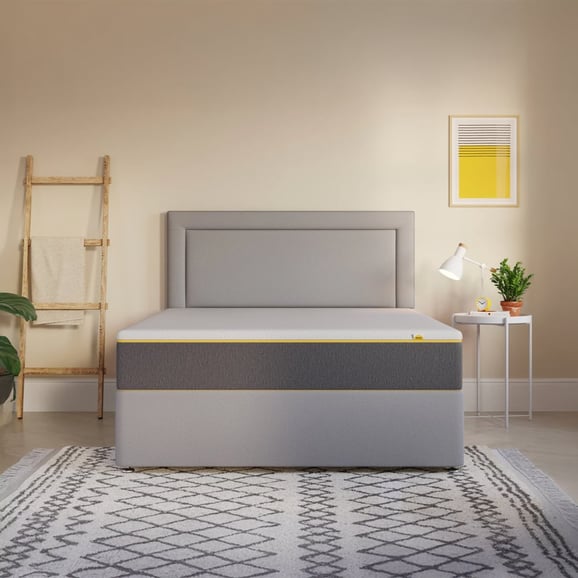
Polymer, wool and gel-infused foam provide the cushioning in this hybrid, which interests me for someone who prefers alternatives to an enveloping memory foam feel. Origin lists a machine-washable zip-off cover with a padded section it calls HexAdapt Pillowtop, followed by bamboo-infused wool and high-elasticity HexaGrid polymer. Next come IceCool ThermoFoam, a gel-infused foam that Origin contrasts with traditional memory foam, then zoned pocketed steel springs and a high-density foam base. I think the polymer layer makes this worth comparing if you enjoy cushioning with some elasticity.
The padded section belongs to the cover, so include that cushioning when you judge the overall feel. Check the washing directions before removing the cover, too. This mattress arrives boxed, which is worth planning for if unpacking and positioning it will require help. Its care instructions call for rotation from head to foot, with no need to flip, so make sure that routine is manageable for you. Origin does not recommend an adjustable bed base for this mattress. If that's the base you intend to use, leave this model off your shortlist.
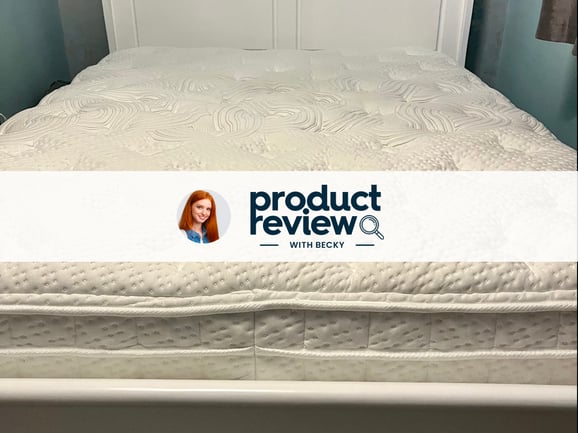
If you like foam cushioning and want springs underneath, this gel-foam combination is one I favour comparing. Dreams lists ActiGel foam and Purfibre fillings over pocket springs, under a knitted cover described as graphite-infused. That is a different comfort-layer mix from the Origin's polymer and wool. For me, gel foam is a reasonable compromise for someone drawn to foam, but the ingredient alone doesn't establish how readily you'll turn over. Compare the feel as you move, rather than choosing on the gel name alone.
The rotation schedule is a reason to pause before ordering if moving a mattress takes planning. Dreams describes this model as single-sided and calls for frequent rotation early on, followed by monthly rotation. If that routine won't be practical, look for a mattress with care requirements you can manage. Base compatibility also needs checking: Dreams lists this mattress as incompatible with its Sleepmotion adjustable beds. Choose another mattress for a Sleepmotion base, and get confirmation for the exact pairing if you intend to use another adjustable base.
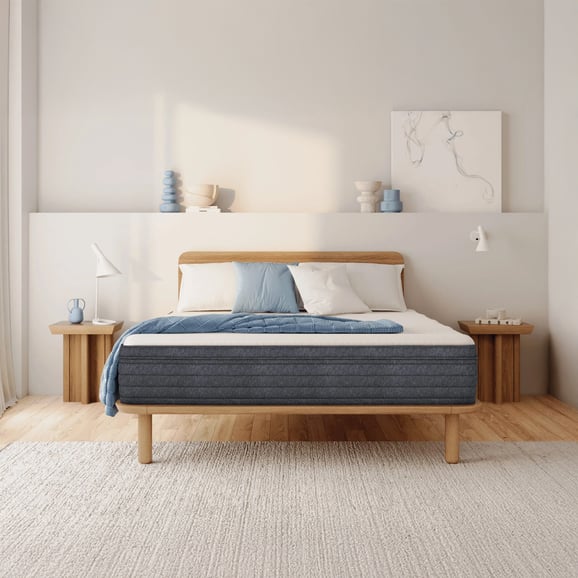
The spring layers near the surface distinguish this build from the other two examples. Simba lists small pocketed Aerocoil microsprings as well as a pocketed steel spring base called SupportCore. The construction also includes British wool and bamboo, Simbatex comfort foam, a foam stability layer and a foam base layer. A washable knitted cover zips off over an internal cover. For someone interested in cushioning alongside springs near the sleeping surface, I think this is an appealing combination to compare, with the Simbatex feel something to judge for yourself.
Use the period allowed by the return terms to decide whether the Simbatex cushioning feels comfortable when you settle down and change position. For washing, remove only the outer cover and leave the internal cover in place. If you need to wash the internal cover too, look elsewhere unless Simba confirms suitable care instructions. The outer cover being washable doesn't establish that every fabric layer is washable. Before buying, ask how this model should be rotated and whether flipping is permitted, because Simba gives no flipping instruction for it.